
Platformless AI
AI Without the Platform
Trustless•Private•Censorship-Resistant
What is Platformless AI?
Platformless AI is a decentralized peer-to-peer network for accessing AI models without trusting a centralized company. Unlike traditional AI services, there's no platform that can censor your prompts, access your data, or deplatform you.
✗ Traditional AI Platforms
- Trust the company with your data
- Accept their terms and censorship rules
- Pay their markup prices
- Risk deplatforming
✓ Platformless AI
- End-to-end encryption (your data, your keys)
- Smart contract payments (trustless settlement)
- P2P model access (no platform gatekeepers)
- Open source (verify everything)
Built by Fabstir, powered by Base/opBNB, secured by STARK proofs.
Private Fine-Tuning
Every other capability here consumes a model. Fine-tuning produces one. Train a LoRA adapter on your own encrypted dataset (support transcripts, a house style, a proprietary domain) on a rented GPU you don't own, and walk away with a model only you can decrypt.
1. Encrypt & upload
Your dataset is sharded and each shard encrypted under its own fresh key on your device, then uploaded to decentralised S5 storage. The pointer is the authorisation, and the storage network never holds a key.
2. Train in slices
The host verifies every shard against its manifest hash, re-counts your tokens and scans the content before a single GPU cycle is spent. It then trains in slices, delivering each encrypted checkpoint to you before it claims payment on-chain.
3. Decrypt your adapter
The finished LoRA adapter comes back sharded and encrypted, its manifest hash bound into the final on-chain attestation. You alone hold the keys. Attach it to a chat session and the model answers in your voice, on your domain.
Pay per slice, not per job
A run that dies halfway bills only for the slices that finished. Cancel and you are billed the same way. A job rejected before any GPU work settles to zero and frees your deposit.
Counting you can check
Your client and the host count tokens in two languages and must agree exactly, pinned by a frozen fixture generated from the exact tokenizer bytes the template names. A false declaration is rejected instead of quietly resizing your escrow.
Session-isolated serve-back
An adapter is staged private to one session, applied only to the requests in that session, and removed when it ends. It is never visible to another session on the same base model, and its key is minted host-side, never taken from the wire.
Told when it fails
If the adapter cannot be staged, the chat says so and names the base model it is answering from. You never silently pay for a fine-tune you are not getting.
Zero new smart contracts
Fine-tuning rides the same escrow, per-slice proofs, dispute window and 90/10 split as inference. It is just a session with its own registered model id. Because a slice is a token budget rather than anything language-specific, video LoRA training sits on the identical rails.
Where the trust boundary sits
Your corpus is encrypted in transit and at rest, staged files are wiped on every exit path, and the adapter is re-encrypted before it leaves. But the host must decrypt your dataset to train on it. Confidential computing is the route that closes that window, rather than something already in place.
How can we help?
Search our knowledge base for answers to all your questions about Platformless AI
General FAQ
Users
Hosting
How Platformless AI Works
A decentralized architecture powered by smart contracts, cryptographic proofs, and peer-to-peer networking
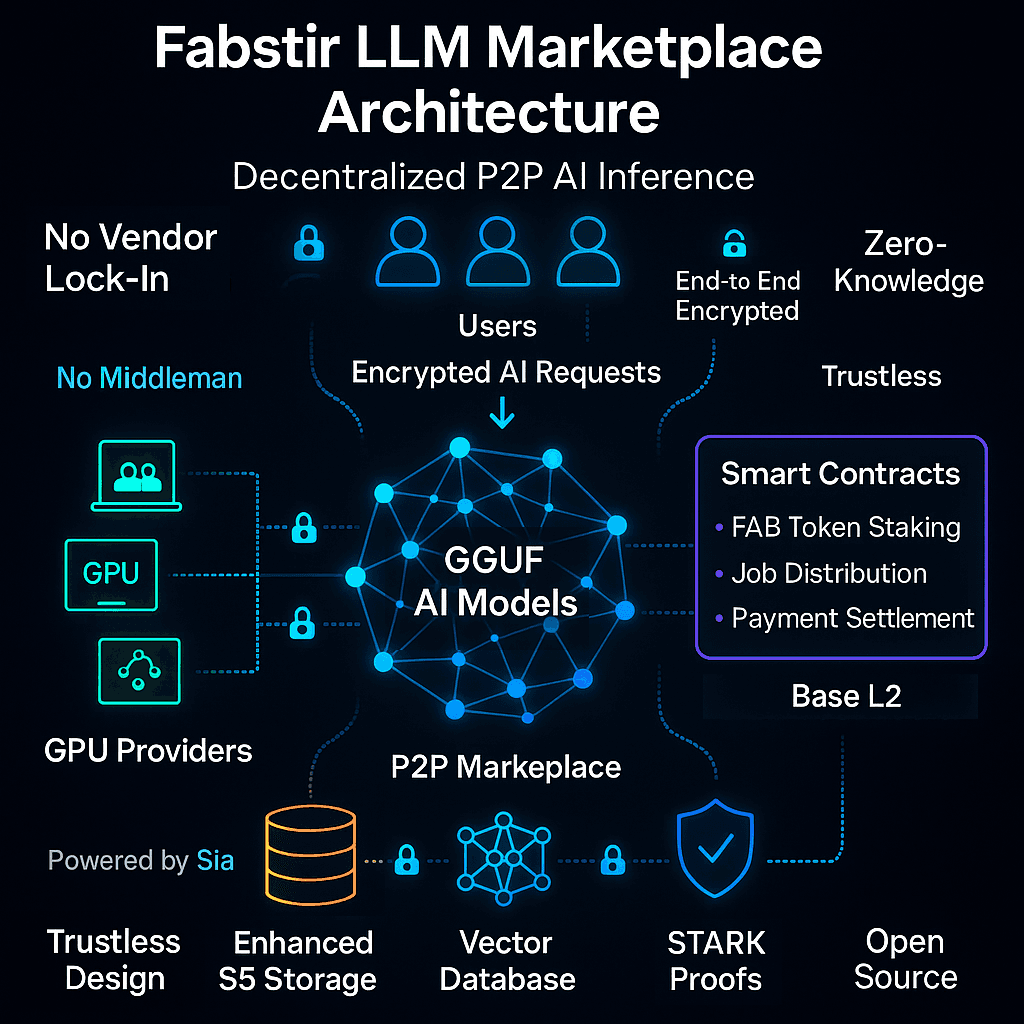
Open source • Verifiable • Trustless • Audited